Known versus unverified
Space9 KYC Australia: Verification Before Deposits and Withdrawals
 Available in US
Space9 uses identity verification, or KYC, in deposit and withdrawal workflows. The current FAQ says KYC is required for a first Visa/MasterCard or crypto deposit, while the current withdrawal guide says identity verification may need to be completed before a withdrawal. A current public Space9 terms page also says verification can include proof of identity, proof of address and confirmation of payment-method ownership.
What is not fixed by the approved evidence is a universal processing time. This page therefore does not promise that KYC takes a particular number of minutes or hours. It also does not turn a general document category into a guarantee that every account will be asked for the same file in every situation.
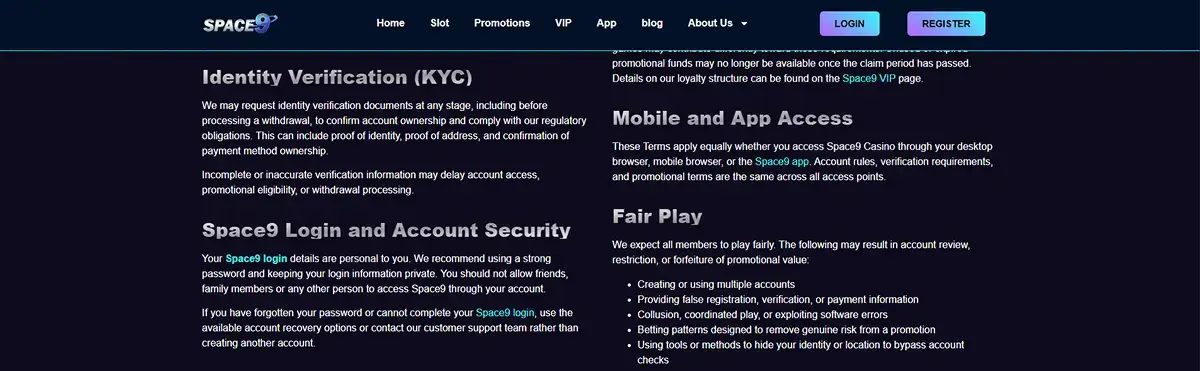
Table of Contents
- What is verified now
- Why Space9 KYC can appear at more than one stage
- Current document categories
- KYC before deposits
- KYC before withdrawals
- How to prepare without guessing requirements
- What this page does not claim
- Protecting sensitive verification material
- How to read a verification request carefully
- How the verified KYC triggers fit together
- Bottom line
What is verified now
| KYC point | Status | Evidence-safe conclusion |
|---|---|---|
| KYC exists | Verified | Identity verification is part of Space9 deposit and withdrawal workflows. |
| First card or crypto deposit | Verified trigger in current FAQ | The FAQ says first Visa/MasterCard or crypto deposits require KYC. |
| Withdrawal verification | Verified | The withdrawal guide says identity verification may be required before a withdrawal. |
| Document categories | Verified on current public terms | Terms say verification can include proof of identity, proof of address and payment-method ownership. |
| Exact processing time | Not verified | No fixed completion-time promise is published here. |
Why Space9 KYC can appear at more than one stage
The current evidence supports KYC in both deposit and withdrawal contexts. That is why it is better to think of verification as an account-control process rather than as one single screen that always appears immediately after registration. A person can have a functioning login and still encounter identity checks later when a payment method or withdrawal is involved.
This distinction also prevents confusion with the Space9 account guide. OTP confirms part of the account-access flow; KYC is a broader identity and account-ownership check connected to financial activity. They can coexist without being the same mechanism.
Current document categories
A same-session check of the current public Space9 terms page supports three categories that can be requested for identity verification: proof of identity, proof of address and confirmation of payment-method ownership. The terms frame these as possible verification evidence rather than as a promise that every user always submits the same set.
That wording matters. “Proof of identity” is a category, not permission to invent a Space9-specific list of acceptable passports, licences or other documents. “Proof of address” likewise does not establish a universal age limit for a statement or bill unless the current instructions give one. Payment-method ownership means the operator can ask for evidence connecting the payment method to the account holder, but the exact format can depend on the method and the account review.
Deliberate limit
This guide publishes the verified categories, not a made-up checklist of file types, image dimensions, expiry rules or turnaround times.
KYC before deposits
The current Space9 FAQ states that KYC is required for the first deposit made through Visa/MasterCard or cryptocurrency. That is a specific trigger supported by the present brand-facing FAQ. It should not be generalized into a claim that every deposit method follows exactly the same sequence.
Before using a payment route, confirm the payment-method information shown in the current cashier and keep account details consistent. The broader Space9 payment methods covers which deposit categories are verified without importing unsupported KYC timing or limit claims.
KYC before withdrawals
The current Space9 withdrawal guide says identity verification should be completed if required before a withdrawal is submitted. The current terms page also says verification can be requested before processing a withdrawal. These two current sources support the connection between payout readiness and account verification.
They do not support a universal promise that verification finishes within a particular time. If a payout is pending, separate the questions: first determine whether the account is waiting on verification; then check the actual withdrawal status and payment route. The Space9 withdrawals handles the second part without turning a KYC page into a payout-speed claim.
How to prepare without guessing requirements
The safest preparation is procedural rather than speculative. Use accurate account information, use payment methods that belong to the account holder, and respond only through a verified Space9 account or support route. If the account asks for evidence, follow the live instructions shown for that review rather than relying on an old forum post or generic casino checklist.
- Check the domain before uploading any sensitive document.
- Read the current request and provide only what is actually requested.
- Make sure account and payment-owner details are consistent.
- Do not edit documents to conceal mismatches or bypass checks.
- Do not share KYC files through an unsolicited message or unknown upload link.
- Keep a record of the request and submission route if follow-up is needed.
What this page does not claim
The available sources do not establish a fixed Space9 KYC processing time, so this page does not publish one. It does not claim that one document set is mandatory in every case, that a particular file will always be accepted, or that completing KYC guarantees an immediate withdrawal.
It also does not treat KYC as evidence of an Australian local licence or regulatory approval. Identity checks and licensing are separate topics. The Space9 licence and AU law handles the regulatory evidence directly.
Protecting sensitive verification material
KYC documents can contain enough information to create a separate identity risk if they are sent to the wrong place. The practical defence is provenance: verify where the request came from, use the account flow you intentionally opened, and avoid re-sending the same documents through multiple unverified channels.
If support is needed, describe the verification stage and ask which official route should be used. Do not send passwords or active OTP codes with KYC material. Those credentials serve a different purpose and should remain private.
How to read a verification request carefully
When a KYC request appears, separate the category being requested from the exact evidence the live account flow accepts. The current terms support proof of identity, proof of address and payment-method ownership as categories. The on-screen request should determine the actual evidence needed for that account review.
Check whether the request explains what information must be visible and where the file should be submitted. Avoid adding extra personal information that was not requested. If the wording is unclear, use a verified support route to ask for clarification rather than guessing, altering a document or sending files through a different channel.
This is also why this page does not publish a universal “KYC checklist” copied from another operator. A generic list can sound useful while being wrong for the current Space9 workflow. The live request and current terms are the relevant reference points.
How the verified KYC triggers fit together
The deposit and withdrawal references describe two different moments in the same account-control process. For a first Visa/MasterCard or cryptocurrency deposit, the current FAQ identifies KYC as part of that first-use flow. Withdrawal guidance, by contrast, says identity verification can need to be completed before a payout proceeds. A reader should therefore check the stage of the account rather than assume that verification happens only once, only at sign-up, or only when money is withdrawn.
The document categories supported by the current public terms help explain what a request is trying to establish. Proof of identity relates to who controls the account, proof of address relates to the account holder’s stated details, and payment-method ownership relates to the connection between the account and the method being used. These categories are useful for interpreting a live request, but they still do not create one fixed Space9 document bundle for every account.
OTP should also be kept separate from KYC. Space9 uses OTP verification in its account flow, but a one-time code is an access or confirmation mechanism, not a substitute for identity evidence requested during a payment review. Completing an OTP step therefore does not establish that a later KYC request has been satisfied. The practical check is simple: read the status shown in the account and respond to the specific verification step that is actually outstanding.
Before a withdrawal, this distinction can prevent unnecessary confusion. If the account shows a verification request, deal with that request first through the verified account route. If no verification action is shown, do not invent one from a generic checklist. The live account instructions determine the current task, while the public terms define the categories Space9 says it can use.
Bottom line
The verified KYC picture is now clearer than a generic “verification may be required” statement. Space9’s current FAQ ties KYC to first Visa/MasterCard or crypto deposits, the withdrawal guidance ties identity checks to payout readiness, and the current public terms say the evidence can include proof of identity, proof of address and payment-method ownership.
The remaining uncertainty is timing and case-specific detail. Follow the live request shown for the account, do not invent a universal document checklist, and keep sensitive files inside verified channels. For the site’s broader context, return to the Space9 Australia guide.
Written by the editors at Space9 Casino.