Space9 account access for Australian readers
Space9 Account Australia: Registration, Login and OTP Security
 Available in US
Space9 uses OTP verification in its account flow. Its current FAQ says registration requires an OTP checkpoint, login uses the registered mobile number and password, and the Forgot Password route also uses OTP verification. The same FAQ says only one device can be logged in at a time. These are account-access facts, not a recommendation to open or fund an account.
The more important practical issue is provenance. Search results can surface several similarly named Space9 properties, so a reader should verify the current player-facing route before entering a mobile number, password, OTP or payment information. This page therefore treats registration and login as an account-security workflow rather than a conversion funnel.
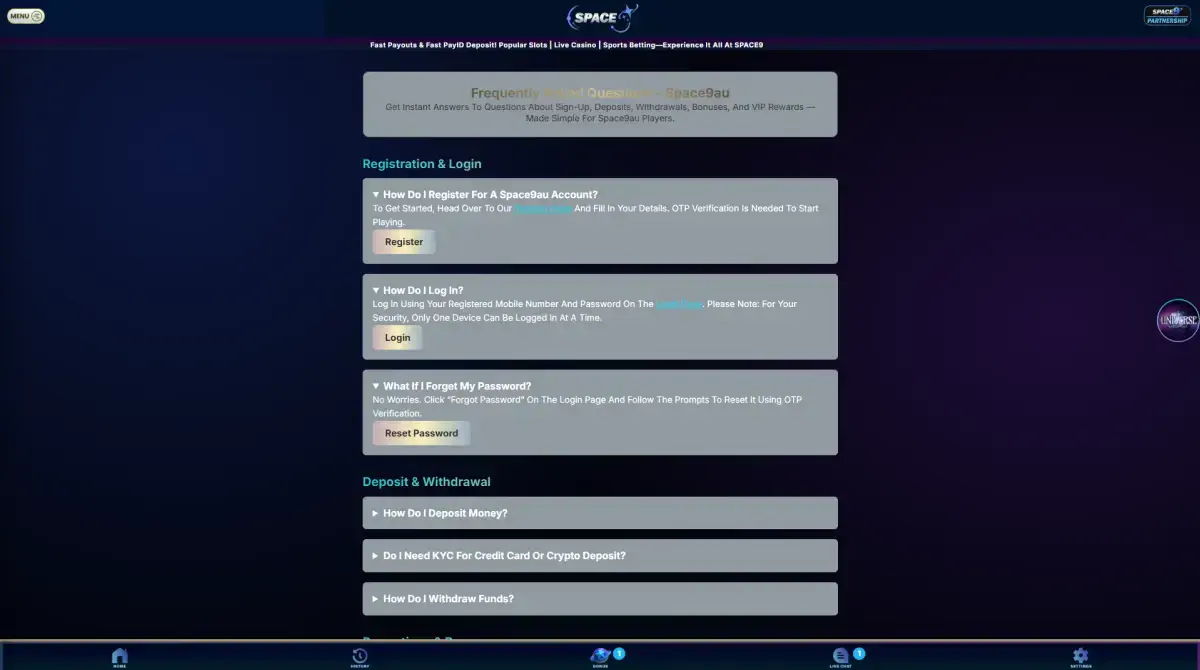
Table of Contents
- Space9 account flow at a glance
- Why domain checking comes before registration
- Registration without the sales language
- How the current Space9 login works
- Forgotten password and OTP recovery
- When account access meets payments
- Support: use it for account state, not credential sharing
- Account access does not settle licensing questions
- Practical account-security checklist
- What to record when access fails
- Account changes deserve the same verification discipline
- Bottom line
Space9 account flow at a glance
| Account stage | What is verified | What to check |
|---|---|---|
| Registration | Space9 uses OTP verification in the account flow. | Confirm the current Space9 property before entering personal details or a one-time code. |
| Login | The current FAQ says login uses the registered mobile number and password. | Do not reuse credentials on a lookalike page or unrelated Space9-branded domain. |
| Device access | The FAQ says only one device can be logged in at a time. | A session conflict can therefore be an account-state issue, not necessarily a broken password. |
| Password recovery | The current Forgot Password flow uses OTP verification. | Start recovery from the verified account route rather than from an unsolicited message. |
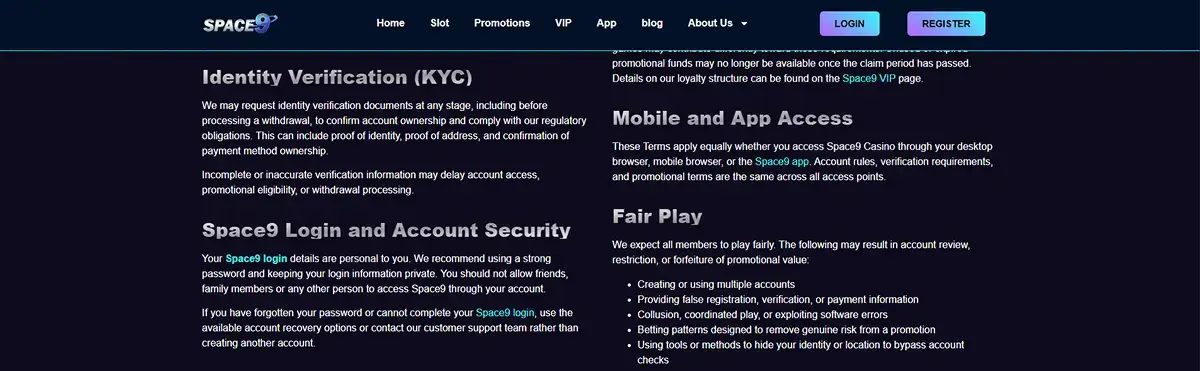
| KYC | Identity verification is used in deposit and withdrawal workflows. | Use the dedicated Space9 KYC guide for verified document categories and the limits of what is known. |
Why domain checking comes before registration
Available source material identifies space9aus.com as the active Australia-facing player site. That matters because a brand name alone is not enough to establish that a page is the same operator surface. Search engines, advertisements, old pages, mirrors and similarly named sites can all produce links that look plausible at a glance.
Before entering a mobile number or account credential, check the hostname in the browser. Do this again after a redirect. A polished logo, familiar colour scheme or a page title containing “Space9” is not a substitute for checking the actual destination. If a page arrived through a message or a saved bookmark that has not been used for some time, open the known reference route independently and compare the address.
Account-security rule
Treat the domain, password and OTP as parts of the same trust decision. Verifying one but ignoring the others defeats the purpose of the checkpoint.
Registration without the sales language
The useful way to describe Space9 registration is as an identity-and-contact setup process with an OTP checkpoint. The current FAQ confirms the OTP requirement. It does not justify promotional claims that registration is a path to guaranteed returns, nor does this guide treat the existence of a registration route as evidence of Australian regulatory approval.
Use accurate information and keep control of the mobile number used for the account. An OTP is normally short-lived and should be treated like a credential: it should be entered only into the account flow you intentionally opened. Do not send a one-time code to another person who claims they need it for “verification” or “support”.
If the flow changes between screens, check the address bar before continuing. Registration pages often collect the most sensitive combination of details on the site, so this is a poor place to rely on visual familiarity alone.
How the current Space9 login works
The current FAQ says login uses the registered mobile number and password. It also states that only one device can be logged in at a time. That second point is useful when diagnosing a failed or interrupted session because it creates a specific account-state possibility: another active session can matter.
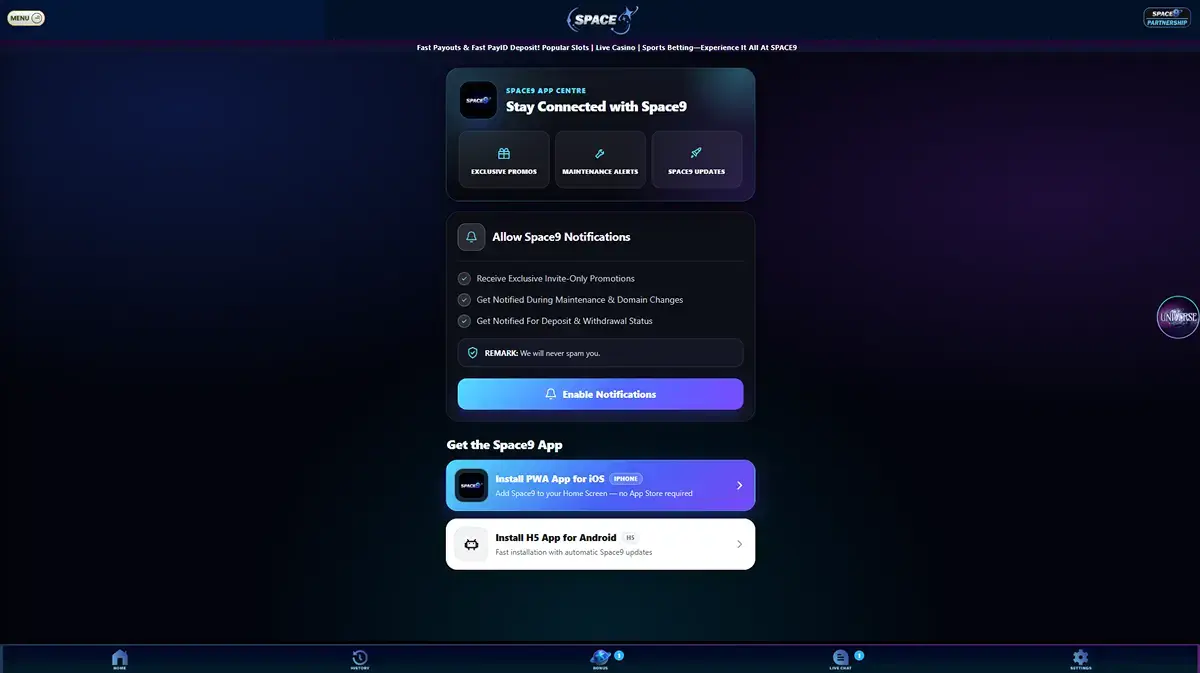
Do not respond to a session problem by immediately creating a second account. First, verify that you are on the expected route, confirm the mobile number being used, and use the normal recovery process if the password is not accepted. If the issue follows a device switch, the Space9 mobile explains the difference between browser, iPhone PWA and Android H5 access without treating those delivery modes as separate accounts.
Forgotten password and OTP recovery
Space9’s current FAQ says the Forgot Password route resets access using OTP verification. The safest recovery path is therefore one you initiate yourself from the verified account page. Avoid password-reset links sent unexpectedly through social media, messaging apps or email unless you independently confirm where they lead.
- Open the verified Space9 account route yourself.
- Use the normal Forgot Password option.
- Check that the OTP request corresponds to the recovery action you just started.
- Enter the code only on the expected Space9 page.
- Choose a new password that is not reused on unrelated services.
This sequence is practical because it reduces the chance of treating an unsolicited OTP request as legitimate. The OTP proves control of a communication channel at that moment; it should not be handed to a third party.
When account access meets payments
Registration and login are only one layer of the account. Deposits and withdrawals introduce separate payment and verification checks. Space9 uses identity verification in those workflows, so a user who can sign in successfully can still encounter a later KYC step. That is normal separation between account access and financial-account verification, not evidence that login failed.
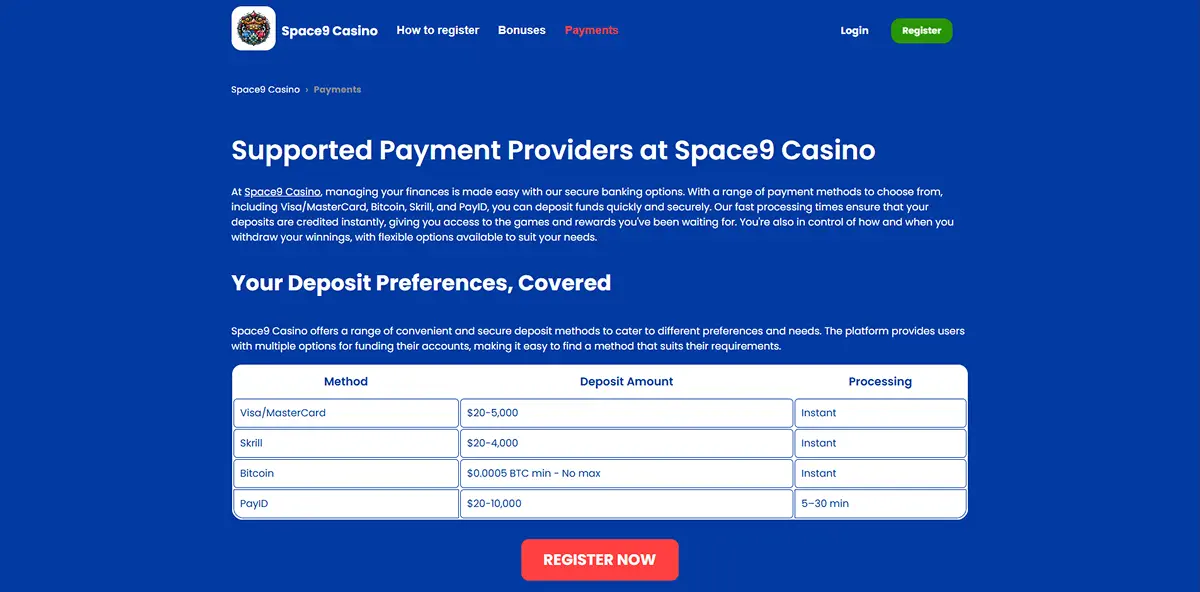
For the verified payment categories and the limits of the available evidence, use the Space9 payment methods. For payout-specific checks, use the Space9 withdrawals. Keeping those topics separate prevents a login page from becoming a dumping ground for unsupported timing, limit or payment claims.
Support: use it for account state, not credential sharing
Space9 provides 24/7 live chat support, and the available source material also supports email support. Those channels are appropriate when a verified account route still does not work, when a session appears stuck, or when an account-security event needs explanation.
Support availability does not change the basic credential rule. Do not disclose a password or one-time code merely because someone identifies themselves as support. A legitimate troubleshooting conversation can establish the account context without asking you to hand over the secret that authenticates the session.
Useful information to prepare
The account identifier you normally use, the approximate time the problem occurred and a neutral description of the error.
Information to protect
Your password, active OTP and unnecessary copies of sensitive documents.
If a payment or withdrawal is involved
Move the issue to the payment or withdrawal context rather than treating it only as a login problem.
Account access does not settle licensing questions
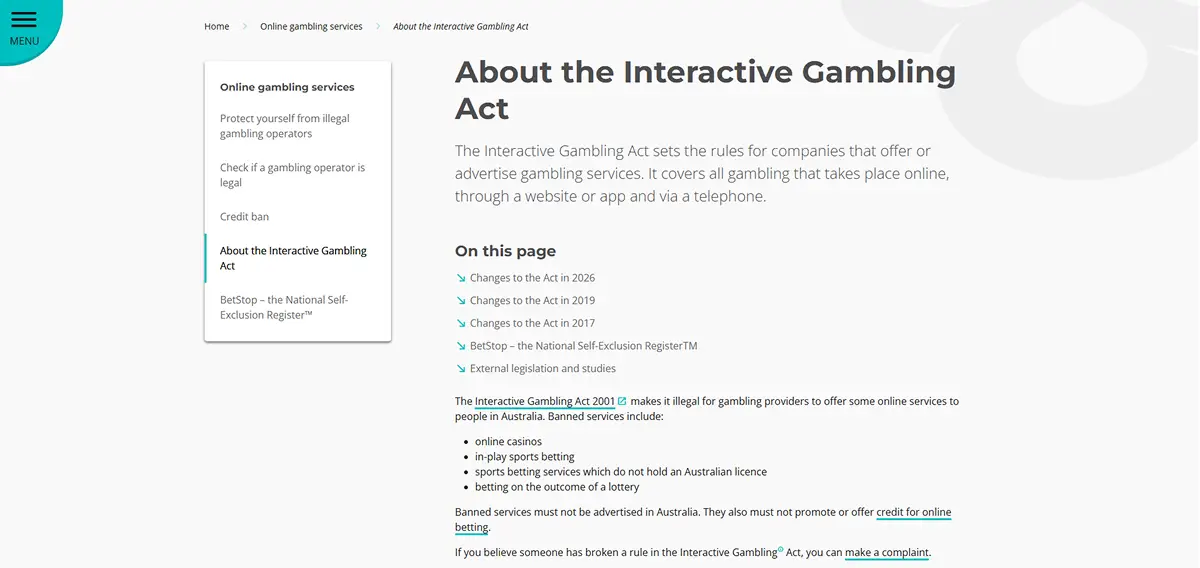
A working registration or login route does not prove that an operator holds an Australian local licence or that a particular service has a specific regulatory status. Those are separate questions. This site keeps the account instructions neutral and puts the regulatory evidence on the Space9 licence and AU law.
That separation is deliberate. It prevents interface observations, payment support or the existence of an OTP flow from being misread as a regulatory endorsement.
Practical account-security checklist
- Verify the current player-facing hostname before entering credentials.
- Treat OTP codes as secrets and enter them only into a flow you initiated.
- Remember that the current FAQ says one device can be logged in at a time.
- Use the normal Forgot Password route instead of creating a duplicate account when access fails.
- Keep registration information accurate and under your own control.
- Separate login issues from KYC, payment and withdrawal questions.
- Use verified support channels if account state remains unclear.
What to record when access fails
A useful troubleshooting note is factual and minimal. Record which route you opened, whether the problem occurred before or after the OTP step, whether the device had an existing session, and the exact wording of any error that does not expose sensitive information. That makes it easier to distinguish a credential problem from a session problem or a page-loading problem.
A screen capture can help when it shows an error message or page state, but crop out passwords, OTPs, balances and unnecessary personal information before sharing it with support. If the error appears immediately after a redirect, include the destination hostname in your own notes so you can verify whether the session stayed on the expected property.
This approach is more reliable than repeatedly retrying with different credentials. Repeated trial-and-error can obscure the original failure point, while a short sequence of observations preserves enough context to explain what happened without exposing secrets.
Account changes deserve the same verification discipline
Security checks should not stop after the first successful login. If an account later prompts for a new OTP, a password reset or a verification step, confirm that the request matches an action you initiated. A code requested by an unexpected page or message should be treated as a warning sign until the source is verified.
Device changes are another point where users can confuse convenience with identity. A new browser, PWA shortcut or Android H5 route can change session behaviour, but it does not create a new identity. Keep the same account details consistent and use recovery or support rather than opening parallel accounts to work around a session issue.
Bottom line
Space9’s current account flow has three verified checkpoints that matter most for this guide: OTP is used in the account process, login uses the registered mobile number and password, and password recovery uses OTP. The FAQ also says only one device can be logged in at a time.
The best way to use those facts is defensively. Check the current domain before entering account data, keep control of passwords and one-time codes, and move KYC or money-movement questions to their dedicated pages. For the site’s broader context, return to the full Space9 overview.
For related detail, see Space9 KYC.
Created by the ”Space9 Casino” editorial team.