Online Casino Reload Bonuses in Australia: How They Work
 Available in AU
A reload adds promotional credit to a later deposit, while the match rate and offer terms shape what can be played and withdrawn.

Table of Contents
- What a Reload Bonus Adds to a Deposit
- The Bonus Amount Is Only One Part of the Offer
- The Turnover Calculation Behind a Reload
- Free Spins and Game Restrictions
- Bitcoin and PayID: Check Eligibility Before Depositing
- No-Deposit Bonuses Are Not Always No-Wagering Bonuses
- How No-Deposit Free Spins Are Activated and Restricted
- Reloads Within the Wider Retention Cycle
What a Reload Bonus Adds to a Deposit
A reload bonus is a deposit promotion offered after a player’s initial sign-up offer. It adds bonus funds calculated as a percentage of a later deposit. The deposit remains the player’s own money; the matched portion is promotional credit, not an extra cash payment. A reload therefore changes the balance available for play, but it does not make the deposit itself larger or guarantee that the bonus can be withdrawn.
The word “reload” describes the timing of the offer. It refers to depositing again after the account has already been opened, rather than making the first qualifying deposit associated with a sign-up offer. The percentage match is the central mechanic: a qualifying deposit is used as the basis for calculating the bonus amount. The precise result depends on the promotion’s stated rate and the deposit that qualifies. Those details belong to the terms of each offer; the label alone does not establish them.
Reload offers are generally presented at a lower percentage rate than sign-up offers. That difference reflects their place in the promotional sequence: the sign-up offer is directed at a new account, while a reload is directed at a later deposit. It does not mean every reload is automatically better or worse value. The percentage describes only how much bonus credit is attached to the qualifying deposit. It does not, by itself, describe the conditions attached to that credit or the final amount that could be withdrawn.
A reload bonus can add value to repeat deposits, but the terms and the payment details matter as much as the offer itself. Use this list as a starting point for checking which operators’ available details fit your needs in Australia.
License: Curacao eGaming OGL/2023/174/0082 (Dama N.V.) · Min. deposit: A$15 LevelUp Casino lists a minimum deposit of A$15 and a Curacao eGaming licence held by Dama N.V. under reference OGL/2023/174/0082.
License: Curacao Golden Pokies is listed as operating under a Curacao licence. The available details provide no further basis for assessing its reload bonuses.
License: Curacao (operating since 2017) · Min. deposit: A$20 Uptown Pokies has operated since 2017 and is listed as Curacao-licensed. Its minimum deposit is A$20.
License: Tobique Gaming Commission · Payout speed: crypto ~10-15 minutes, fiat 1-5 days · Min. deposit: A$30 SkyCrown is listed under the Tobique Gaming Commission. Its stated payout estimates are around 10–15 minutes for crypto and 1–5 days for fiat, with a minimum deposit of A$30.
License: Curacao Gaming Control Board OGL/2023/176/0095 (Hollycorn N.V.) Rollero Casino is listed under the Curacao Gaming Control Board, licence OGL/2023/176/0095, held by Hollycorn N.V.
License: Curacao · Min. deposit: A$20 (POLi) Lucky Dreams is listed as Curacao-licensed, with a minimum deposit of A$20 for POLi.
License: Curacao Gaming Control Board OGL/2023/174/0082 (Dama N.V.) SpinsUp is listed under the Curacao Gaming Control Board, licence OGL/2023/174/0082, held by Dama N.V.
License: Curacao · Payout speed: crypto 30-60 minutes, fiat 1-5 days · Min. deposit: A$10 Wild Tokyo is listed as Curacao-licensed. Its stated payout estimates are 30–60 minutes for crypto and 1–5 days for fiat, and its minimum deposit is A$10.
License: Curacao eGaming (Hollycorn N.V., since 2017) · Min. deposit: A$20-30 (depends on the offer) Playfina Casino is listed as Curacao eGaming-licensed through Hollycorn N.V. and has operated since 2017. Its minimum deposit is A$20–30, depending on the offer.
License: Curacao eGaming (Roby Games Ltd) Roby Casino is listed as Curacao eGaming-licensed, with Roby Games Ltd named as the licence holder.
This distinction matters because promotional language can make bonus credit sound equivalent to cash. It is not. A deposit match is an offer of additional playing balance under the promotion’s rules. Whether any resulting winnings can become withdrawable depends on conditions that are separate from the basic definition of a reload. The word “bonus” does not remove those conditions, and a percentage match should not be read as a guaranteed return on the deposit.
A simple way to understand the mechanics is to separate the transaction into two parts. First, the player makes a qualifying deposit. Second, the promotion applies its stated percentage to determine the bonus credit. The deposit and the bonus may appear together in an account balance, but they have different origins and may be treated differently under the offer’s rules. The deposit is funds paid into the account; the reload is promotional credit attached to that deposit.
This is what distinguishes a reload from a straightforward deposit. A deposit transfers funds to an account. A reload bonus is an additional promotional component that may be applied when the deposit meets the offer’s conditions. Without an eligible promotion, depositing again is simply another deposit. The act of depositing more than once does not, by itself, create a bonus.
It also distinguishes a reload from a sign-up offer. A sign-up offer is associated with becoming a new customer or making an initial qualifying deposit. A reload is associated with a later deposit by someone who already has an account. Both can use a percentage match, so the calculation format may look similar. Their timing and intended position in the customer relationship are different. A reload is not another name for the original sign-up offer, even where both add bonus funds to a deposit.
The term can be used broadly in promotional descriptions, so the label alone is not enough to identify how a particular offer works. A promotion called a reload may specify which deposit qualifies, when the bonus is credited, and what restrictions apply. Those details can vary by offer. The basic meaning remains consistent: a percentage of a subsequent deposit is matched with promotional credit, usually at a lower rate than a sign-up offer. The exact wording of the promotion determines whether a particular deposit meets its stated conditions.
For an Australian audience, the distinction between explaining this term and presenting an offer as available is important. Under the Interactive Gambling Act 2001, operators are prohibited from providing real-money online casino games to people physically located in Australia. Casino-style games such as pokies, poker, blackjack and roulette fall within the prohibited interactive gambling services described by the law. A general explanation of “reload bonus” does not establish that an online casino promotion is lawful, accessible or available to Australian residents.
Legal Prohibition
Under the Interactive Gambling Act 2001, operators are prohibited from providing real-money online casino games to people physically located in Australia.
Accordingly, “online casino reload bonus Australia” should not be taken to mean that a locally permitted real-money casino offer exists. The phrase describes a promotional mechanic used in online casino marketing; it does not change the legal position or create an entitlement to claim a bonus. Nor does a deposit match make a prohibited service permissible. The geographic fact that matters is where the customer is physically located, not merely the currency or wording used in an advertisement.
A reload is therefore best understood as a category of promotion rather than a promise of value. It identifies a later-deposit match, not a particular payout, a guaranteed cash gain, or a standard set of rules. Its percentage rate indicates how the bonus is calculated, while other parts of the promotion determine how the bonus can be used. Keeping those ideas separate prevents the headline match from being mistaken for the complete financial outcome.
The practical meaning is narrow: after an account has been established, a qualifying subsequent deposit may receive bonus credit calculated as a percentage of that deposit. The rate is typically below the rate attached to a sign-up offer. Beyond that definition, the word “reload” says little on its own. It does not identify a specific operator, confirm eligibility, establish that an offer is available in Australia, or turn promotional credit into withdrawable cash.
The Bonus Amount Is Only One Part of the Offer
A headline bonus figure does not establish how much value an offer has. Its practical worth depends on the conditions attached to it: how the wagering requirement is calculated, when the promotion expires, whether a cash-out cap applies and which account activities can be combined with it. A larger advertised amount can therefore leave a player with less usable value than a smaller offer with less restrictive terms.
There is also a legal limit that changes how this information should be read in Australia. The Interactive Gambling Act 2001 prohibits operators from providing real-money online casino games, including pokies, poker and table games, to people physically located in the country. Promotional language about reloads does not alter that position. This is an explanation of how bonus conditions affect their stated value, not an endorsement or invitation to use an online casino service.
Read the conditions as a package
The amount shown in a promotion is only one line in a set of rules. A meaningful assessment also considers the deposit conditions, wagering requirement, deadline, eligible games and any limit on cashing out. Each term affects a different part of the result. A generous headline can be offset by a short expiry, restrictive play conditions or a cap that limits the amount available for withdrawal.
- Assess the obligation attached to the offer before assigning value
- Prioritise lower wagering requirements over larger bonuses
- Consider the deposit conditions, deadline, and eligible games as a package
- Treat a larger advertised amount as a guarantee of more usable value
- Assume a generous headline offsets restrictive play conditions
- Rely on the headline alone if terms are ambiguous or scattered
The wording matters because a promotion may distinguish between bonus funds and winnings, or set different conditions for each. The exact definitions determine how the offer is administered. If the terms do not clearly explain what must happen before funds can be withdrawn, the headline alone cannot resolve the uncertainty. Treating an unclear offer as though it were unrestricted would amount to assigning it value that the rules have not established.
A specialist review reports that some promotions carry time limits or maximum cash-out caps. Those conditions should not be treated as universal features of every reload offer; they are terms that may apply and need to be checked in the relevant promotion. A deadline can reduce the time available to meet requirements, while a cap can limit the amount payable even if the account balance is higher. They affect different parts of the calculation, so one does not compensate automatically for the other.
Compare obligations, not just advertised value
Wagering requirements are a central comparison point because they set the amount of play required before bonus-related funds become withdrawable. A higher headline does not make that obligation disappear. A specialist review advises prioritising lower wagering requirements over larger bonuses with more restrictive conditions. That is a sound way to compare the written terms: assess the obligation attached to the offer before assigning value to the promotional amount.

This comparison should use the same basis for each offer. The rules need to show what balance the requirement applies to and how qualifying play is counted. If two promotions use different definitions, their stated requirements cannot be compared as though they were identical. The relevant calculation is not the most prominent number in an advertisement; it is the obligation produced by the applicable terms.
Other restrictions also affect whether an offer can be used as described. A promotion may set a minimum deposit or restrict play to particular games, according to specialist reviews. Those conditions can narrow eligibility or limit how the bonus is used. They should be read alongside the wagering rule rather than treated as minor details. A headline that looks attractive before these restrictions are considered may offer little practical advantage once they are included.
The comparison does not require a complicated score. It requires the terms to be visible and understandable. If an important condition is absent, ambiguous or scattered across separate rules, the offer cannot be reliably assessed from its headline. The gap is not evidence that the condition is favourable; it is a reason not to assume a particular outcome.
Check expiry and cash-out limits separately
An expiry date controls how long a promotion remains available or how long its conditions can be met, depending on the wording. Those are not necessarily the same thing. The terms need to state what expires, when the clock starts and what happens to any remaining bonus or associated winnings. Without those details, the mere presence of a deadline does not show how it affects the final amount.
An expiry date and a maximum cash-out cap are separate restrictions that can interact, meaning a player may face both a limited time and a ceiling on withdrawable funds.
A maximum cash-out cap is a separate restriction. It can place a ceiling on the amount that may be withdrawn from a promotion, even where the account balance is larger. A specialist review notes that such caps can appear in bonus terms, but that does not establish that every reload includes one. The relevant cap, if any, must be stated in the terms for that specific offer.
These conditions can interact. A player may face both a limited period and a maximum payable amount, so checking only one leaves the other unaccounted for. The final assessment must consider the deadline, the cap and the wagering condition together. A generous advertised amount does not make those terms less binding.
Check whether promotions can be combined
A bonus may sit alongside other promotional arrangements, but their compatibility should not be assumed. A specialist review recommends checking whether a bonus can be combined with loyalty points or cashback. The answer depends on the relevant rules; the presence of more than one promotion does not establish that all benefits accrue at once.
Claiming multiple deals can also have consequences. A specialist review reports that activating more than one offer may cause some promotions to cancel each other. This is not a rule that can be applied to every operator or offer. It is a reason to establish which promotion is active and what happens to any other benefit before treating the combined value as available. Otherwise, a comparison may count rewards that cannot be received together.

The same care applies when a promotion refers to loyalty activity or other account rewards. The terms should make clear whether participation affects bonus eligibility or the treatment of accumulated benefits. If the rules do not settle that point, the combined value remains uncertain. Adding promotional amounts together on paper does not prove that they can be collected together.
What “best” can and cannot mean
There is no useful universal answer to what online casino has the best reload bonuses for people in Australia. A headline alone cannot settle the question, and a comparison of offers would also imply that real-money online casino services are available as lawful offerings to Australian residents. Under the Interactive Gambling Act 2001, operators are prohibited from providing those services to people physically located in Australia.
As a terms-based concept, the strongest offer would be the one whose conditions produce the most favourable result for the person eligible to receive it. That assessment would depend on the wagering requirement, expiry, any cash-out cap, game restrictions, deposit conditions and compatibility with other promotions. A large advertised amount is not a substitute for those details. Nor can an offer be called best solely because it has fewer visible conditions; the complete terms determine the outcome.
For any promotion being assessed as written material, the useful questions are precise: what must be done, by when, what limits apply, and which other benefits are forfeited or unavailable? If the rules do not answer those questions clearly, the promotional amount should not be treated as a dependable measure of value. In bonus terms, the small print is not decoration; it is the calculation.
Main Conclusions
- A large advertised amount is not a substitute for detailed terms
- The most favourable offer is determined by wagering requirements, expiry, and cash-out caps
- Small print is the actual calculation of a bonus’s value
- If rules are unclear, the promotional amount is not a dependable measure of value
The Turnover Calculation Behind a Reload
A reload bonus may increase the balance shown after a deposit, but the bonus figure is not the amount that must necessarily be wagered before withdrawal. The wagering requirement determines that turnover. When it is expressed as a multiple of the bonus, the calculation is:
bonus amount × wagering multiple = required turnover
A specialist review gives a worked case: a $500 bonus with a 30x wagering requirement calls for $15,000 in wagers before the bonus converts to withdrawable cash. The arithmetic is direct; the practical consequence is less so. The required turnover is thirty times the bonus, not the bonus plus a small administrative step.
That distinction matters when comparing reload terms. A larger bonus can carry a larger turnover obligation, while a lower bonus with a smaller multiplier may require less total wagering. The headline amount alone cannot establish which offer represents less play before withdrawal. The relevant figure is the turnover produced by the calculation, alongside the conditions governing which wagers count.
The calculation also depends on what the stated multiple applies to. If the terms apply it to bonus funds, the bonus amount is the starting figure. If they instead apply it to a combined deposit-and-bonus amount, the required turnover changes. The label “30x” is therefore incomplete without its base. The full terms need to make clear whether the multiplier applies to the bonus alone, the deposit, or both. Treating those bases as interchangeable produces the wrong total.

Turnover means the total value of qualifying wagers, not a sum that must be lost. A wager can contribute to the requirement even if it does not produce a loss, subject to the offer’s rules. Conversely, a game or bet that is excluded may add nothing to the qualifying total. The balance displayed during play does not by itself show how much qualifying turnover remains; that depends on the promotion’s tracking rules.
A specialist review also notes that offers can set a minimum deposit or confine qualifying play to particular games. Those conditions affect whether a deposit activates the promotion and whether subsequent wagers count toward its requirement. The calculation is useful only after those terms are identified. A deposit below the stated minimum may not trigger the offer, while play outside the permitted game selection may fail to advance the turnover.
The amount at stake is not limited to the bonus balance. Bonus terms can make failure to complete wagering conditions a reason for forfeiting winnings earned through the promotion, as described in a specialist review. That makes the deadline and the definition of qualifying play material to the final outcome: turnover left unfinished when the applicable conditions expire may not lead to a withdrawable balance. The precise consequence depends on the promotion’s rules.
This arithmetic is an explanation of how a promotional condition works, not an indication that real-money online casino play is available in Australia. Australian law prohibits operators from providing online casino games, including pokies and table games, to people located in the country. A numerical example can clarify the cost embedded in a condition; it does not change the legal status of the service.
Turnover Calculation
Determine the bonus amount (e.g., $500) and check if the multiplier applies to the bonus alone or the combined deposit and bonus.
Multiply the bonus amount by the wagering requirement (e.g., $500 × 30) to find the required turnover ($15,000).
Check if the deposit meets the minimum requirement and if the games played contribute toward the qualifying total.
For any reload terms being examined, the useful sequence is to identify the bonus base, apply the stated multiplier, then check what deposits and games qualify and what happens if turnover remains incomplete. The resulting wagering total gives a more concrete measure of the obligation than the promotional amount on its own.
Free Spins and Game Restrictions
Free spins can appear alongside a deposit match, but they are a separate part of the promotion. Their value depends on which pokies they can be used on and what happens to any winnings. A headline that combines a reload with spins does not establish that the spins work across the full game catalogue, or that their winnings are immediately withdrawable.
Game eligibility is a practical condition, not a minor detail. If spins apply only to selected pokies, the eligible titles determine where the reward can be used. The terms should identify those games and state whether any other restrictions apply. Without that information, the number of spins alone cannot show what the promotion is worth. “More spins” is a quantity, not a valuation.
Winnings may also have a separate wagering condition. A specialist review reported a requirement to wager free-spin winnings 30 times before withdrawal. That figure belongs to the terms described in that review; it should not be treated as a rule applying to every promotion. The relevant offer’s own conditions determine the actual requirement. If the condition applies to winnings rather than the spin value, the amount that must be wagered is calculated from those winnings, not simply from the advertised number of spins.

This distinction affects comparisons between reload offers. A deposit match and a free-spin component may each have different eligible games and conditions. The match does not cancel the spin rules, and the spin rules do not explain the value of the deposit match. Treating the combined headline as one unrestricted reward obscures the separate conditions attached to each part.
A useful comparison therefore records the eligible games, the basis on which spin winnings are calculated for wagering, and the point at which those winnings may be withdrawn. If the terms do not make those points clear, the offer cannot be assessed reliably. A large spin count cannot compensate for unclear eligibility or a condition that leaves winnings unavailable for withdrawal.
The distinction is particularly relevant to searches for reloads tied to pokies. A promotion may advertise spins on selected games, but that does not establish that every popular game qualifies or that play on other games contributes toward any wagering condition. The game list and contribution rules, where stated, need to be read together. A spin reward with narrow eligibility is not equivalent to unrestricted play; the restriction changes how the reward can be used.
There is no sound basis for calling a reload offer “best” from its headline alone. The relevant comparison is between the applicable terms, not the promotional packaging: eligible pokies, treatment of spin winnings, and the withdrawal condition. Each item can change the result.
Attention A large spin count cannot compensate for unclear game eligibility or conditions that leave winnings unavailable for withdrawal.
In Australia, the legal frame also matters: the Interactive Gambling Act 2001 prohibits operators from providing real-money online casino games, including pokies, to people physically located in the country. Describing promotion terms does not make such services lawful or constitute an invitation to use them.
Bitcoin and PayID: Check Eligibility Before Depositing
A payment method and a reload promotion are separate parts of an offer. A cashier may show a method for funding an account, while the promotion’s terms may exclude deposits made through that method. Availability for a transaction therefore does not, by itself, establish eligibility for a bonus.
A specialist review reports that some casinos exclude certain payment methods from promotional eligibility. That is a limited observation, not a rule that applies to every service or every offer. It does not establish whether Bitcoin or PayID is accepted, whether either qualifies for a reload, or whether a particular service is accessible in Australia.
For a Bitcoin reload, the relevant distinction is between a deposit made with cryptocurrency and a deposit that counts under the promotion’s conditions. The same distinction applies to a reload funded through PayID. The method named in a payment menu is not enough to settle the question: the promotion’s own conditions determine which deposits qualify. If those conditions exclude a method, a deposit made through it may not trigger the advertised bonus, even if the transaction itself is accepted.

That difference affects the value being assessed. A reload is not simply the amount credited to an account; it is an offer with its own eligibility conditions. If the deposit does not qualify, the bonus component cannot be treated as part of the transaction. A headline description that mentions a reload but says nothing clear about the relevant payment method leaves a material condition unresolved.
The terms need to connect the payment method to the promotion explicitly. Relevant wording may state which deposit methods are eligible, whether exclusions apply, and whether the conditions differ between promotions. General payment information and bonus terms serve different purposes: the former describes funding, while the latter governs whether a promotional reward is attached. Treating one as a substitute for the other is a poor way to calculate the offer.
Australian legal conditions are a separate and prior issue. The Interactive Gambling Act 2001 makes it illegal for operators to provide real-money online casino games, including pokies and table games, to people physically located in Australia. A payment method or a reload offer does not change that position. Nor does a promotional label establish that a service may lawfully be provided to someone in Australia. Offshore casino services are subject to active blocking and enforcement.
This distinction matters particularly when promotional material presents payment options as a practical route into a real-money casino. A method’s name, whether Bitcoin or PayID, should not be read as evidence of legal availability, local authorisation, or a right to participate. Payment processing and the legality of the underlying gambling service are not the same question.
Availability of a payment method in a cashier menu does not guarantee that deposits made through that method are eligible for a reload bonus.
The useful reading of any payment-related promotion is therefore narrow: identify the stated eligibility rule, distinguish it from general deposit information, and do not infer that an unnamed or unmentioned method qualifies. If the terms do not clearly address the method, the bonus amount cannot be reliably included in a calculation. That is an uncertainty about the offer, not evidence that the method is eligible.
Bitcoin and PayID may appear in searches for casino reloads, but the wording of a search cannot establish acceptance or qualification. Any claim about a specific service would require current, explicit terms—and would not override Australia’s prohibition on operators providing real-money online casino games to people in the country.
No-Deposit Bonuses Are Not Always No-Wagering Bonuses
“No deposit” describes how a reward is granted; “no wagering” describes what must happen before any resulting funds can be withdrawn. The terms refer to different conditions, even when they appear together in a promotion. A registration reward may be issued without a deposit and still carry rules that restrict access to its value.
A no-deposit bonus can take the form of bonus funds or free spins provided for registering. In some promotions, the reward is intended to let a new user try particular games without first funding an account. That removes the deposit condition for receiving the initial reward; it does not, by itself, establish that winnings are immediately withdrawable.
The distinction matters because the original reward and any winnings produced with it are separate stages. A promotion can require no payment to receive the reward while imposing a wagering condition on winnings before withdrawal. A specialist review has reported wagering requirements on winnings from no-deposit free spins. That is a report about a particular offer, not evidence of a universal rule. The applicable promotion terms determine the condition.
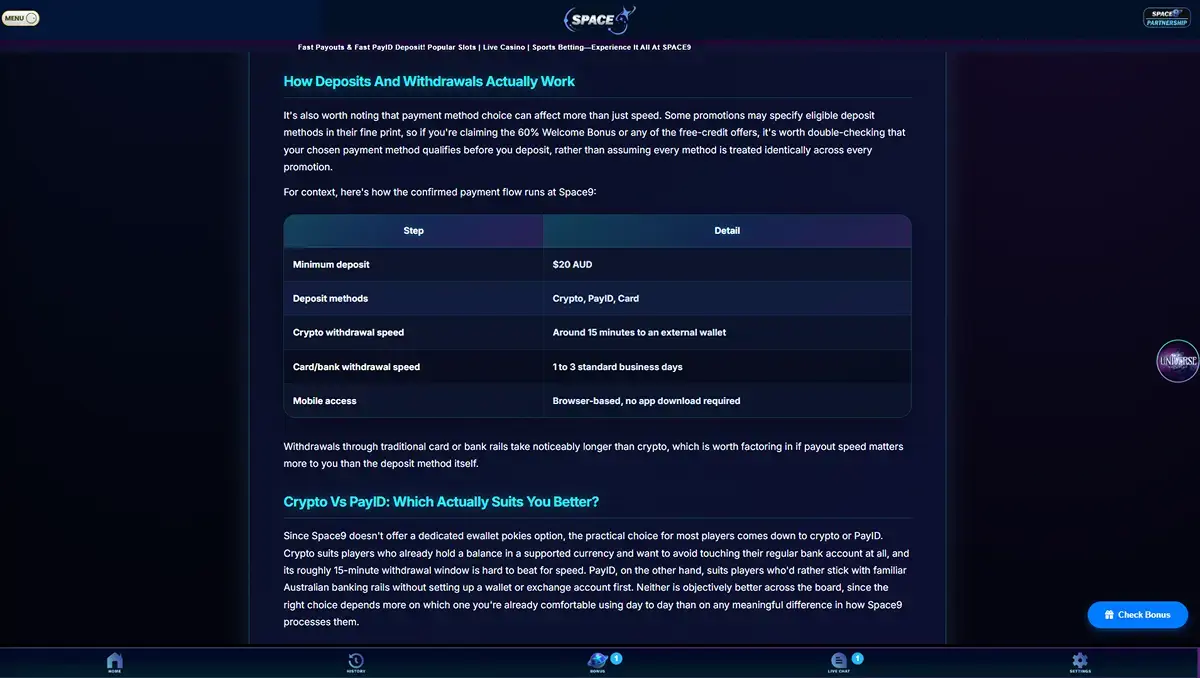
A reload bonus works differently at the entry point: it is tied to a later deposit, whereas a no-deposit bonus is granted for registering without making one. The words “no deposit” therefore cannot be used to infer that a reload has no deposit requirement, or that a registration reward has no withdrawal conditions. The labels answer separate questions.
For a financial comparison, the useful distinction is between the cost of receiving a reward and the conditions attached to its proceeds. A no-deposit offer may remove the initial funding step, yet still leave a requirement to meet before winnings can be withdrawn. If that condition is not met, the apparent value of the reward may not translate into cash available for withdrawal. “No deposit” is not a synonym for “no wagering.”
This distinction is informational, not an invitation to use such services in Australia. Under the Interactive Gambling Act 2001, providing real-money online casino games—including slots, poker and table games—to people physically located in Australia is illegal for operators. A promotion’s label does not alter that legal status. The terms may describe how an offshore offer is structured, but they do not make the service lawful to provide in Australia.
How No-Deposit Free Spins Are Activated and Restricted
Reloads Within the Wider Retention Cycle
Reloads, cashback and loyalty rewards operate on different bases. A reload is linked to a subsequent deposit; cashback is calculated as a percentage of losses over a defined period. One specialist review describes that period as often weekly, but the timing depends on the offer.
Loyalty programs work through accumulated points that can be exchanged for bonus cash, free spins or other rewards. The balance is built through the program rather than being a direct return on a particular deposit or loss.
These mechanisms are not interchangeable: each has its own trigger and value calculation. A promotion’s place in a retention cycle matters less than the terms that determine what is credited and what conditions apply.
Can players win real money from free spins if they have no wagering?
Yes. If the free spins have no wagering requirement, winnings can be withdrawn, but a maximum cash-out limit may apply.
What does a no-wagering bonus mean?
It means the bonus winnings do not have to be wagered a set number of times before withdrawal. The offer may still restrict eligible games or cap the amount that can be cashed out.
Do Australian online casinos offer free spins and welcome bonuses in 2026?
No lawful real-money online casino offer is available to people physically located in Australia: operators are prohibited from providing those services under the Interactive Gambling Act 2001. Promotional advertising does not make an offer legal or accessible.
Prepared by the Space9 Casino editorial staff.